
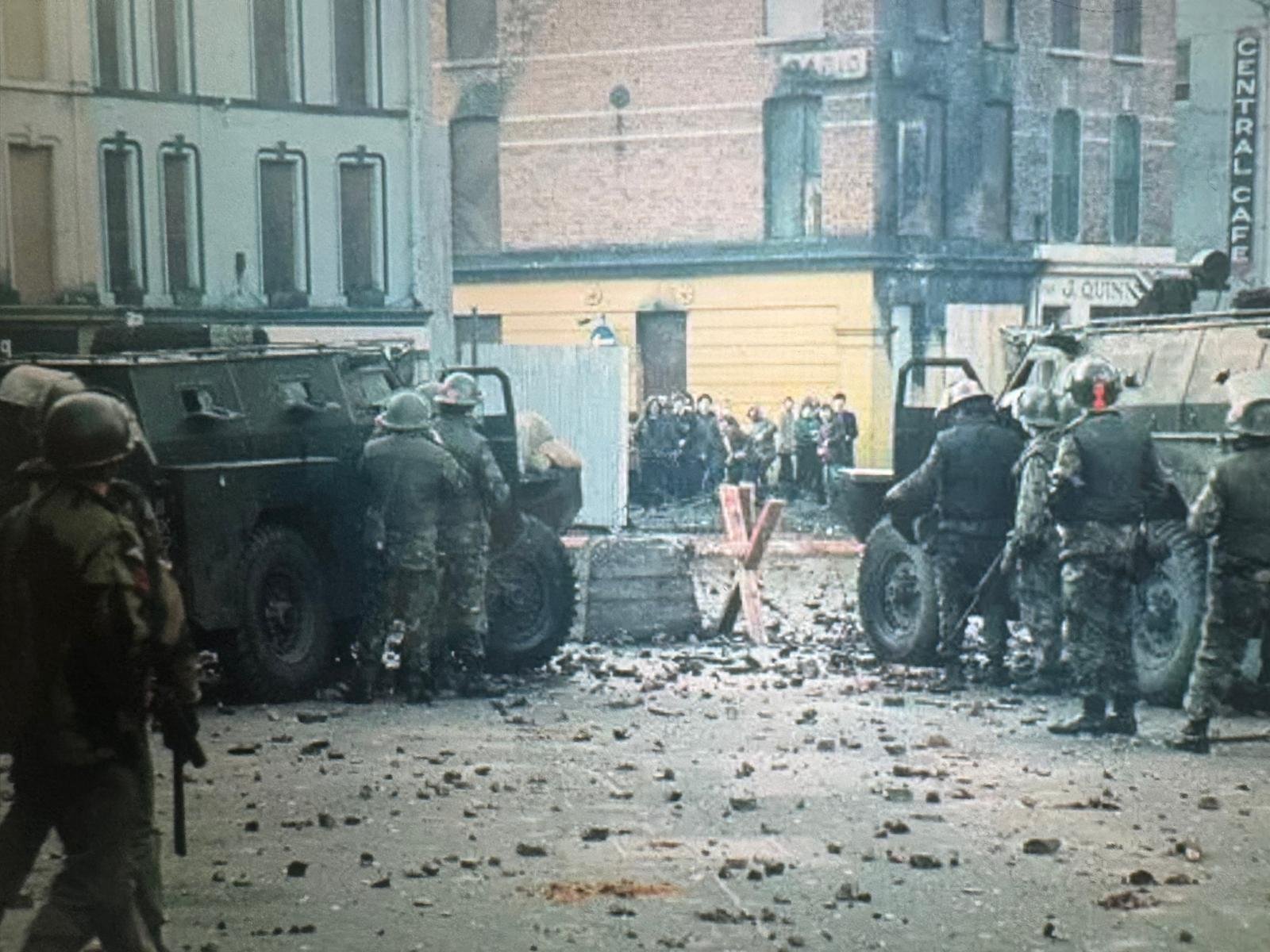
On August 12, 1969, the streets of Derry erupted in violence that would mark one of the defining moments in Northern Ireland’s turbulent history. The Battle of the Bogside wasn’t an explosion of sectarian hatred—it was the inevitable culmination of decades of systematic discrimination, political exclusion, and mounting frustration that had reached a breaking point in this predominantly Catholic city.
Seeds of Conflict: Derry’s Divided Society
To understand the significance of the Battle of the Bogside, one must first grasp the peculiar circumstances that made Derry a powder barrel waiting to explode. Despite having a substantial Catholic and nationalist majority, the city remained under firm unionist control through a combination of gerrymandered electoral boundaries and property-based voting restrictions that effectively disenfranchised much of the Catholic population.
This wasn’t merely political exclusion—it translated into tangible hardships in daily life. Catholic families faced systematic discrimination in housing allocation, employment opportunities, and basic municipal services. The Bogside, a densely populated Catholic area, bore the brunt of this neglect, with substandard housing conditions and limited economic opportunities creating a sense of profound injustice among residents.
The Civil Rights Movement Emerges
By 1968, frustration had crystallized into organized resistance. The Derry Housing Action Committee emerged as a powerful voice for change, joining forces with the Northern Ireland Civil Rights Association (NICRA) to demand basic equality for Catholics in the city. Their goals were fundamentally moderate: fair housing allocation, equal employment opportunities, and the end of discriminatory voting practices.
However, many unionists viewed NICRA with deep suspicion, seeing it not as a legitimate civil rights organization but as a front for radical republican groups seeking to undermine Northern Ireland’s place within the United Kingdom. This perception would prove crucial in escalating tensions, as unionists increasingly viewed any Catholic civil rights demands as existential threats to their political dominance.
Violence Erupts: The Prelude to August 1969
The situation deteriorated rapidly in late 1968 and early 1969. Civil rights marches and protests in Derry were met with violent counter-demonstrations by unionists, while the Royal Ulster Constabulary—widely perceived by Catholics as a partisan force—often failed to intervene or protect peaceful demonstrators. When they did act, it was frequently against the civil rights protesters themselves.
The authorities’ response was to ban the Civil Rights Association and other protest groups, but this heavy-handed approach only intensified underlying tensions. Rather than addressing the legitimate grievances that had sparked the protests, the bans simply drove frustration underground, where it continued to fester and grow.
The Apprentice Boys March: A Calculated Provocation
The spark that ignited the Battle of the Bogside came in the form of a seemingly traditional event: the annual march of the Protestant Apprentice Boys of Derry on August 12, 1969. Approximately 15,000 members of this loyalist organization had been granted permission for their customary parade, despite police advice against allowing it to proceed.
The march commemorated a historic Protestant victory and followed a route that took it provocatively close to the Catholic Bogside area. For Catholic residents, this wasn’t merely a celebration of Protestant heritage—it was a “calculated insult” that deliberately rubbed their faces in their political subjugation and second-class status within their own city.
The symbolism was unmistakable: at a time when Catholics were demanding basic civil rights and facing violent suppression, thousands of Protestants would parade through their neighborhoods celebrating Protestant supremacy and unionist dominance.
From Pennies to Petrol Bombs: How Violence Escalated
What began as symbolic provocation quickly descended into physical confrontation. Some marchers threw pennies at Catholic residents watching from their homes—a gesture loaded with contempt and designed to humiliate. The Catholic response was swift: marbles fired from slingshots targeted the marchers, marking the first exchange of projectiles.
From this seemingly minor incident, violence escalated with frightening speed. Stones began flying from both sides and before long, the more dangerous petrol bombs made their appearance. What had started as mutual taunting had transformed into a full-scale riot that would consume the city for days.
The Barricades Go Up: Creating the No-Go Zone
As violence intensified, Catholic residents of the Bogside took a fateful step that would define the character of the conflict for years to come: they erected barricades to seal off their neighborhood from both the marchers and the forces of the state. These makeshift barriers, constructed from whatever materials could be found, represented more than mere defensive measures—they were a declaration of independence from a state that Catholics felt had utterly failed to protect their rights and interests.
When members of the Royal Ulster Constabulary arrived at these barricades, they found themselves facing not just physical obstacles but the organized resistance of an entire community. The police response was to flood the area with tear gas, turning the Bogside into a chemical warfare zone where residents struggled to breathe in their own homes.
Three Days That Changed Everything
For three grueling days, from August 12 to 14, 1969, the Battle of the Bogside raged. Catholics fought running battles with the RUC, defending their barricades while enduring constant bombardment with tear gas. The police, for their part, found themselves facing an unprecedented challenge: an entire neighborhood in open revolt against state authority.
The intensity of the conflict can be measured in its human cost—over 1,000 people were injured during those three days. But the deeper significance lay in what the battle represented: the complete breakdown of any Catholic faith in the Northern Ireland state’s ability or willingness to treat them fairly.
A Turning Point in History
The Battle of the Bogside marked a crucial turning point in Northern Ireland’s history. When the British Army was finally deployed on August 14 to restore order, it represented not just the end of three days of rioting but the beginning of what would become known as The Troubles—a conflict that would consume Northern Ireland for the next three decades.
The events of August 1969 demonstrated that the old system of unionist dominance and Catholic acquiescence was no longer sustainable. The civil rights movement had awakened a political consciousness among Catholics that could not be suppressed through traditional methods of control. At the same time, the violent response to Catholic demands had convinced many that peaceful protest was futile, setting the stage for the emergence of more radical republican organizations.
Legacy of the Bogside
The Battle of the Bogside remains a defining moment in Northern Irish history, not just for what happened during those three days in August, but for what it set in motion. The barricades that went up in 1969 would remain in place for years, creating “no-go areas” that effectively placed parts of Derry beyond the reach of state authority.
More profoundly, the battle shattered any remaining illusions about the possibility of reform within the existing system. For Catholics, it proved that their demands for basic equality would be met with violence. For unionists, it confirmed their fears about Catholic disloyalty and the existential threat posed by any concessions to nationalist demands.
The images of Catholics defending their barricades against tear gas attacks, of a community under siege in their own city, would become powerful symbols in the republican narrative. Equally, the spectacle of parts of a UK city being sealed off by insurgent barricades would galvanize unionist opinion in favor of ever-tougher security measures.
In this way, the Battle of the Bogside became both a product of Northern Ireland’s divided society and a catalyst for its further division. What began as a struggle for civil rights had evolved into something far more fundamental: a conflict over the very nature and legitimacy of the Northern Ireland state itself. The three days of August 1969 in Derry had set Northern Ireland on a path toward three decades of violence from which it would only slowly, and at enormous cost, eventually emerge.